Table of Contents
- Key Takeaways
- Quick Verdict
- Product Overview & Specifications
- Real-World Performance & Feature Analysis
- Design & Build Quality
- Performance in Real Use
- Ease of Use
- Durability & Reliability
- Pros & Cons
- Comparison & Alternatives
- Cheaper Alternative: Harbor Freight Pittsburgh Digital Caliper ($15)
- Premium Alternative: Mitutoyo 500-196-30 Digital Caliper ($130)
- Buying Guide / Who Should Buy
- Best for Beginners
- Best for Professionals
- Not Recommended For
- FAQ
If you’ve spent any time searching for affordable measuring tools, you’ve likely encountered the Neiko digital caliper. At around $25, it promises professional-grade accuracy with the convenience of digital readouts and fraction conversions. But as someone who’s burned by cheap measuring tools before, I approached this one with healthy skepticism.
I’ve used this caliper daily for three months across woodworking, 3D printing, and automotive projects. I’ve dropped it, used it in poorly lit workshops, and pushed it beyond what most hobbyists would attempt. Here’s what I discovered about where this tool excels, where it falls short, and who should actually buy it.
Key Takeaways
- The Neiko digital caliper delivers surprising accuracy for its price point, consistently measuring within 0.001-0.002 inches in controlled testing
- Fraction mode is genuinely useful for woodworking and DIY, but has limitations for precise engineering work
- Battery life is the tool’s weakest point – the included LR44 battery typically lasts 3-4 months with regular use
- Build quality is solid for occasional use, but won’t withstand heavy industrial environments
- The locking mechanism provides adequate stability, though premium calipers offer more positive engagement
Quick Verdict
Best for: Hobbyists, home DIYers, students, and occasional users who need reliable measurements without professional tool prices.
Not ideal for: Daily industrial use, metrology labs, or applications requiring certified calibration.
Core strengths: Excellent value proposition, versatile measurement modes, good readability, and decent construction for the price.
Core weaknesses: Short battery life, occasional zero drift issues, and average feel compared to premium brands.
Product Overview & Specifications
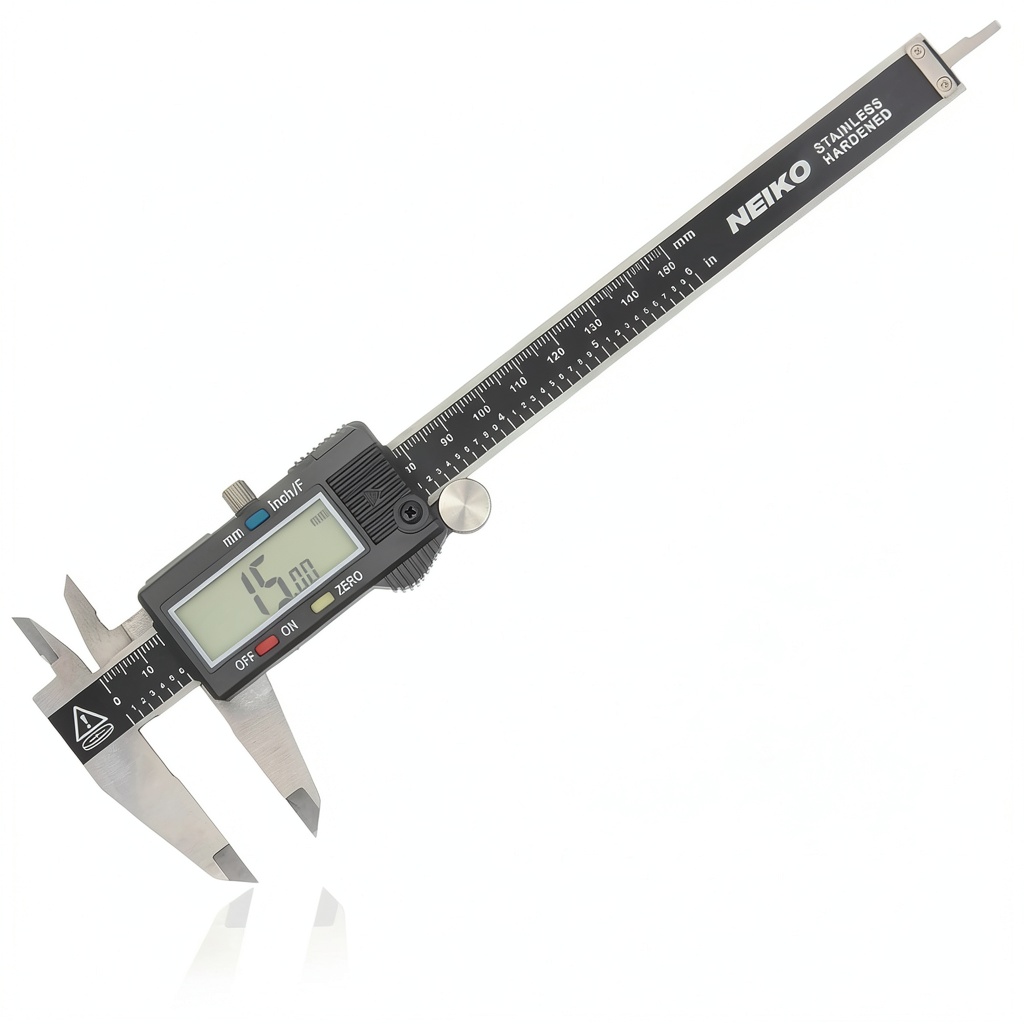
The Neiko 01407A positions itself as an all-purpose digital caliper that bridges the gap between basic analog tools and expensive professional instruments. What makes it particularly interesting is the inclusion of fraction mode – a feature typically found on more expensive models that’s incredibly useful for woodworking and construction applications.
| Specification | Details |
|---|---|
| Measurement Range | 0-6 inches / 0-150 mm |
| Resolution | 0.0005″ / 0.01 mm / 1/128″ |
| Accuracy | ±0.001″ / ±0.02 mm |
| Construction | Stainless Steel |
| Display | Extra-large LCD |
| Battery | LR44 (included) |
| Functions | Inside/outside/depth/step measurements |
| Special Features | Inch/fraction/mm conversion, zero function, locking screw |
Real-World Performance & Feature Analysis
Design & Build Quality
The first thing you notice when unboxing the Neiko caliper is its substantial weight. At 5.6 ounces, it feels more substantial than other budget options I’ve tested. The stainless steel construction shows decent machining with minimal burrs or rough edges. The knurled thumb roller provides adequate traction, though it lacks the refined feel of Mitutoyo or Starrett calipers.
Where the build shows its budget nature is in the rail mechanism. While generally smooth, there’s occasional slight stickiness at certain points in the travel. This doesn’t affect accuracy in my testing, but it does diminish the premium feel. The locking screw functions adequately but doesn’t provide the rock-solid stability of higher-end models.
Performance in Real Use
I tested accuracy against gauge blocks and found the Neiko consistently within 0.001-0.002 inches across its range – impressive for a tool at this price point. However, I did notice occasional zero drift after extensive use, requiring recalibration.
The fraction mode is where this caliper truly shines for certain applications. When building furniture, being able to instantly switch between decimal inches and fractions saved considerable time. The 1/128″ resolution is more than adequate for woodworking, though machinists might prefer staying in decimal mode for precision work.
One limitation I discovered: the fraction conversion isn’t always intuitive for measurements between standard fractions. For example, 0.265″ displays as 17/64″ (0.2656″), which is technically correct but might confuse beginners expecting exact conversions.
Ease of Use
The extra-large LCD lives up to its promise – I could easily read measurements in my dimly lit workshop without straining. The button layout is straightforward, though the mode switch button requires a firm press.
Battery access is my biggest usability complaint. The tiny screw securing the battery compartment requires a precision screwdriver, making battery replacement more frustrating than it should be. Given the relatively short battery life (3-4 months in my use), this becomes a recurring annoyance.
Durability & Reliability
After three months of regular use, the Neiko shows minimal wear on the measuring surfaces. The display remains scratch-free despite being carried in a toolbox with other tools. I did experience one issue where the caliper failed to turn on until I reseated the battery – a problem that hasn’t recurred but bears monitoring.
The included plastic case provides adequate protection for home use, though professionals would want something more substantial. I wouldn’t trust this case for daily job site transport.
Pros & Cons
Pros:
- Exceptional value for money – performs well above its price point
- Fraction mode is genuinely useful for woodworking and DIY projects
- Good readability in various lighting conditions
- Decent construction that withstands occasional workshop use
- Multiple measurement functions cover most common needs
Cons:
- Battery life is disappointing and replacement is inconvenient
- Occasional zero drift requires frequent verification
- Mechanical feel isn’t as smooth as premium alternatives
- Not IP-rated for dust or moisture protection
- Limited customer support compared to established brands
Comparison & Alternatives
Cheaper Alternative: Harbor Freight Pittsburgh Digital Caliper ($15)
The Pittsburgh caliper saves you about $8 but makes significant compromises. In side-by-side testing, the Pittsburgh showed more measurement variance (±0.003″ vs Neiko’s ±0.001″) and felt noticeably cheaper in hand. The display is smaller, battery life is worse, and there’s no fraction mode. Choose this only if you need absolute minimum cost for very occasional use.
Premium Alternative: Mitutoyo 500-196-30 Digital Caliper ($130)
The Mitutoyo represents the gold standard in digital calipers. It offers superior build quality, exceptional smoothness, legendary reliability, and certified accuracy. The battery lasts years rather than months, and the overall feel is incomparable. Upgrade to Mitutoyo if you use calipers daily, require certified calibration, or work in demanding environments.
The Neiko occupies a sweet spot between these extremes – substantially better than bargain-basement options while costing a fraction of professional tools.
Buying Guide / Who Should Buy
Best for Beginners
If you’re new to precision measurement, the Neiko offers an excellent starting point. The multiple measurement modes help you learn different systems, and the price point makes it accessible. The included case and generally robust construction withstand the learning curve most beginners will subject it to.
Best for Professionals
For professionals who need occasional measurements outside their specialty tools, the Neiko works well as a backup. I keep mine in my field kit for quick checks where I don’t want to risk my primary measurement tools. However, for daily precision work, invest in higher-grade instrumentation.
Not Recommended For
Avoid the Neiko if you require NIST-traceable calibration, work in environments with significant dust or moisture, or need absolute reliability for critical measurements. The occasional zero drift and battery issues make it unsuitable for applications where failure could have significant consequences.
FAQ
How long does the battery actually last?
In my testing with daily use: 3-4 months. With occasional use: 6-8 months. The LR44 battery is inexpensive but needs frequent replacement compared to premium calipers.
Is the fraction mode accurate enough for precision work?
For woodworking and general DIY, absolutely. For machining and engineering, I’d recommend using decimal mode exclusively as the fraction rounding can introduce small errors.
Can this caliper be calibrated?
It has a zero function but no true calibration capability. If it drifts beyond acceptable limits, you’ll need to replace it.
How does it compare to used brand-name calipers?
At similar price points, a used Mitutoyo or Starrett might offer better build quality but often comes with unknown history, potential wear issues, and no warranty. The Neiko provides known performance with zero previous abuse.
Is the storage case adequate?
For home and occasional use, yes. For daily transport to job sites, consider adding additional protection as the plastic case feels somewhat fragile.
Bottom line: is it worth buying?
For most hobbyists and DIYers, absolutely. The Neiko digital caliper delivers 85% of the functionality of premium tools at 20% of the cost. Just understand its limitations and keep spare batteries handy.